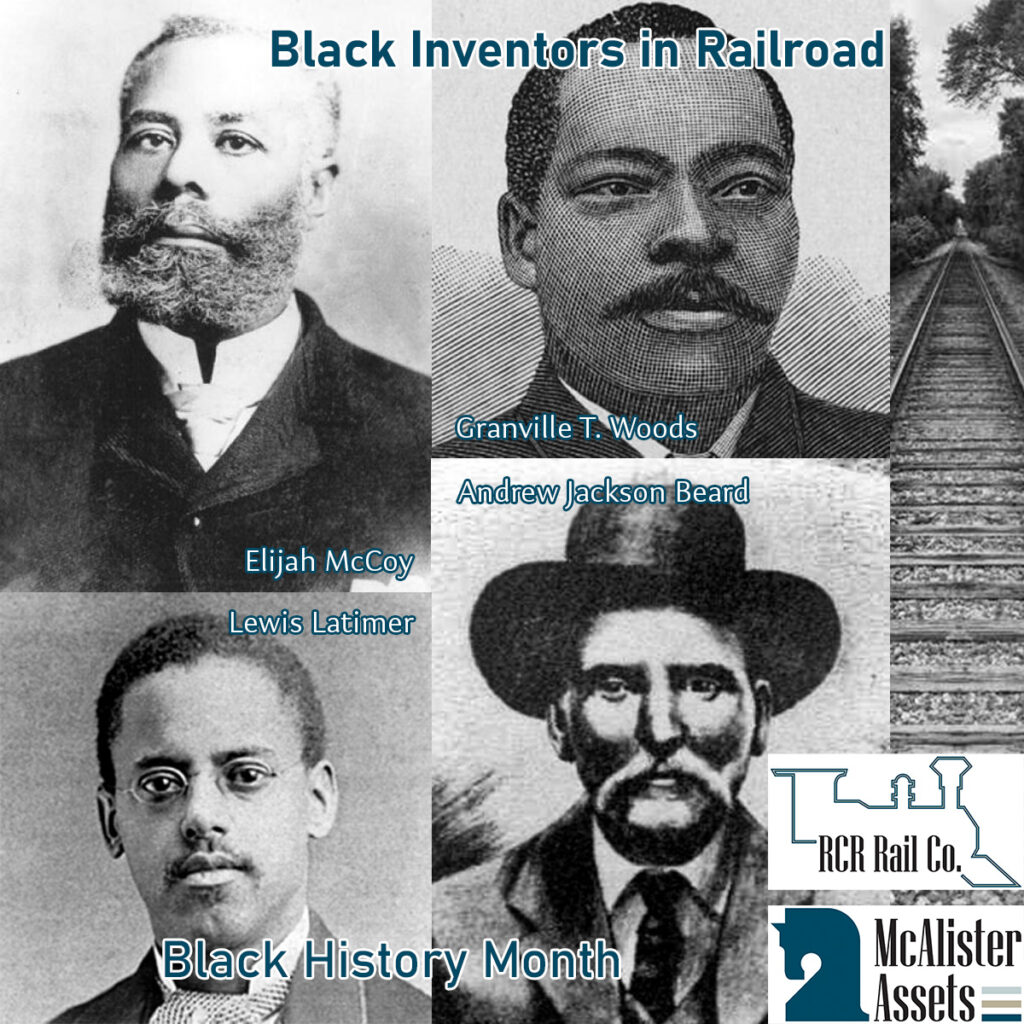
As we celebrate Black History Month, RCR Rail Co. proudly recognizes the extraordinary contributions of Black inventors whose ingenuity shaped the railroad industry into the modern transportation backbone it is today. The rail network that keeps America’s economy moving was built not only by labor and steel, but by brilliant minds whose inventions solved critical safety, efficiency, and reliability challenges. Among the most influential are Elijah McCoy, Granville T. Woods, Lewis Latimer, Andrew Jackson Beard, and several others whose legacies continue to drive innovation in rail shipping.
Their inventions, many created during eras of limited opportunity and significant racial barriers, laid the foundation for safety systems, automation, communication, and mechanical reliability still in use across railroads worldwide. Today, we honor their relentless creativity and acknowledge the enduring impact of their work.
Elijah McCoy – “The Real McCoy” of Mechanical Reliability
Elijah McCoy, the son of formerly enslaved parents who fled to Canada, became one of the railroad industry’s most prolific inventors. After studying mechanical engineering, he worked as a fireman and oiler for the Michigan Central Railroad—roles that exposed him to a persistent operational problem: locomotives had to stop frequently for manual lubrication.
In 1872, McCoy patented the automatic lubricating oil cup, a device that allowed moving engine parts to be continuously oiled without halting a train. This invention drastically improved efficiency, reduced labor, and minimized mechanical wear. Railroads quickly adopted it, and engineers began asking for lubricators “only if it’s the real McCoy,” a phrase inspired by Elijah’s reputation for reliability.
Lasting Impact:
McCoy’s lubrication systems evolved into modern automated lubrication technologies, now essential for minimizing friction, preventing overheating, and reducing maintenance downtime. His breakthrough paved the way for the high‑speed, heavy‑haul freight operations we depend on today.
Granville T. Woods – The “Black Edison” of Rail Technology
Few inventors have shaped railroad communication and safety more profoundly than Granville T. Woods. Holding more than 60 patents—many focused on rail systems—Woods revolutionized how trains operated in an increasingly complex network.
One of his most important contributions was the Induction Telegraph System, patented in 1887. This invention enabled moving trains to communicate with stations and other trains on the line, significantly reducing collisions and improving schedule coordination. Woods also invented enhanced electrical braking systems and automatic circuit breakers, which improved the reliability and safety of electric railcars.
Lasting Impact:
Woods’ communications innovations helped lay the groundwork for modern railway signaling and real‑time dispatch communication technologies. His concept of transmitting information to and from moving trains is echoed today in Positive Train Control (PTC) systems that enhance network safety across North America.
Lewis Latimer – Lighting the Way for Rail Progress
While Lewis Latimer is best known for his work with the lightbulb and telephone, his innovations greatly benefited early rail infrastructure. Latimer invented a method for producing longer‑lasting carbon filaments, which made electric lighting more affordable and practical.
Railroads adopted electric lighting in stations, rail yards, and passenger cars, replacing unreliable gas lamps and improving operational safety. Latimer also worked on electric railcar systems during his time assisting Edison and later Westinghouse.
Lasting Impact:
Latimer’s contributions to lighting technology enabled safer nighttime rail operations and more reliable illumination of maintenance facilities, yards, and stations. His work is foundational to the electrification and modernization of railway environments.
Andrew Jackson Beard – Making Rail Coupling Safer
Rail coupling in the late 19th century was dangerous work. Thousands of workers were injured or killed each year while manually positioning the link‑and‑pin coupling between railcars. Andrew Jackson Beard, a former slave turned inventor, understood the dangers firsthand—he had lost a leg in a coupling accident.
In 1897, he patented the Jenny Coupler, an automatic knuckle coupling mechanism that allowed railcars to connect on impact without a worker standing between them. The Jenny Coupler became the inspiration for the standardized knuckle couplers mandated by the U.S. government in the early 1900s.
Lasting Impact:
Beard’s invention transformed rail safety. Today’s automatic couplers, though technologically advanced, still reflect Beard’s original concept. His work saved countless lives and set the standard for coupling systems worldwide.
William Hunter – Pioneering Railway Safety Brakes
Another significant yet lesser‑known inventor is William Hunter, who patented an improved railway brake system in 1872. His mechanism created better pressure distribution and more reliable braking, reducing derailments and improving stopping control.
Lasting Impact:
Hunter’s innovations contributed to the evolution of air brake systems used today, enabling trains to safely carry heavier loads and operate at higher speeds.
J. B. Winters – Innovator in Railcar Heating
J. B. Winters, an African American inventor who received a patent in 1910, developed an improved train car heating device that circulated warm air more evenly within passenger coaches. This advancement increased comfort for travelers during cold seasons and reduced fuel consumption for heating systems.
Lasting Impact:
While train heating has evolved significantly, Winters’ concept of efficient, evenly distributed heat informs climate‑control designs in modern passenger railcars.
Patricia Bath (Honorable Modern Influence) – Advancing Laser Precision
Though not directly a railroad inventor, Dr. Patricia Bath’s pioneering laser technologies have influenced numerous industries—including precision instrumentation used in railcar manufacturing and maintenance. Her inclusion here honors the broader ecosystem of Black innovation that touches even specialized transportation fields.
A Legacy Driving Today’s Rail Shipping Industry
The innovations of these Black inventors continue to shape rail operations in fundamental ways:
1. Safety Systems
Automatic couplers, early telegraph communication, and improved braking mechanisms all established critical safety standards. Modern railroads depend on their foundational concepts for collision avoidance, employee protection, and secure freight handling.
2. Efficiency and Automation
McCoy’s lubricator introduced automation into mechanical maintenance, an idea central to today’s predictive maintenance technologies, automated inspection systems, and onboard monitoring tools.
3. Communication and Control
Granville Woods’ groundbreaking wireless telegraphy paved the way for networked communication systems. Today’s PTC and digital dispatching echo his early innovations.
4. Passenger Comfort and Infrastructure
From Winters’ heating system to Latimer’s lighting improvements, these inventors helped rail travel become safer and more accessible—qualities still central to both passenger and freight operations.
Honoring the Past, Inspiring the Future
As RCR Rail Co. reflects on these remarkable pioneers, we recognize that progress in the rail industry has always depended on bold thinkers who challenge limitations. The contributions of Black railroad inventors represent innovation born from resilience, determination, and extraordinary creativity.
Their legacies remind us that diversity of thought fuels technological advancement—and that the future of railroading will continue to be shaped by innovative minds from all backgrounds.